
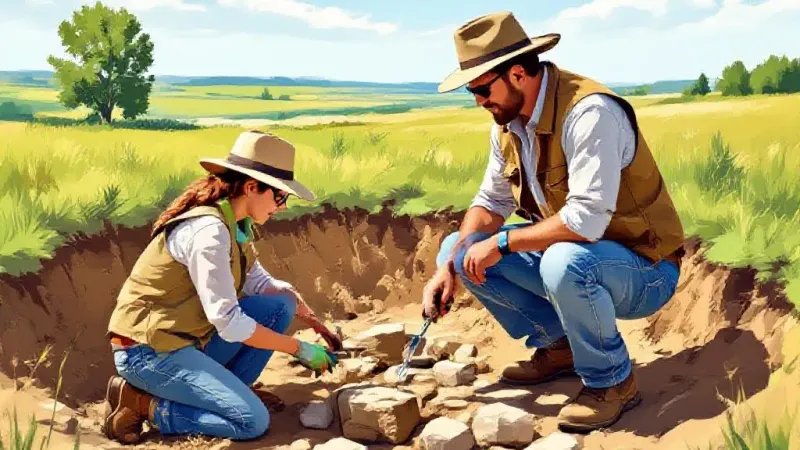
Bismarck, N.D. — Archaeologists have concluded their fieldwork at the North Dakota Governor’s Residence, confirming the discovery of seven coffins containing human remains, along with an additional wooden box. The state reported that the investigation, which involved exploring more than 80 flagged spots on the property, wrapped up on September 14.
The significant discovery began on May 19, when contractors working on the southwest corner of the Governor's Residence property first uncovered human remains, coffin hardware, and fragments. This area is situated near the intersection of 4th Street and Boulevard Avenue in Bismarck. The initial find immediately halted construction work and prompted a radar scan conducted by the State Historical Society to identify potential further burials. Following the radar assessment, a formal excavation dig commenced on September 1.
OMB Facilities Management Director Brandon Solberg indicated that crews diligently investigated over 80 potential locations identified during the initial radar scan and preliminary investigation. The thorough fieldwork, which started on September 1, concluded on September 14, leading to the confirmation of the multiple burials.
The process for handling the newly discovered remains will be extensive and careful. Archaeologists are now tasked with reviewing and cataloging all recovered remains and associated items. This detailed work is expected to continue into early 2027. To ensure the respectful relocation of the remains, the Office of Management and Budget (OMB) has contracted with a local funeral home. Additionally, Crisis Care Chaplaincy has volunteered its services to assist, aiming to handle the relocation process with proper care and reverence. The reburial of the remains is anticipated to take place in the spring of 2027, at a local cemetery.
The discovery at the Governor's Residence property has historical roots, as the site served as Bismarck’s first community cemetery. Records indicate that the property functioned as a burial ground from 1873 to 1877. While it was widely believed that most of the graves from this original cemetery were relocated to St. Mary’s and Fairview cemeteries during the 1880s, previous projects have demonstrated that some burials were inadvertently left behind. For instance, thirteen burials were uncovered during a project in 1903, and five more were found in 1959, underscoring the potential for further discoveries on the historically significant grounds. The current findings continue this pattern, highlighting the complex history beneath the city's surface. The meticulous work of archaeologists and involved agencies reflects a commitment to respectful handling of these historical remains.