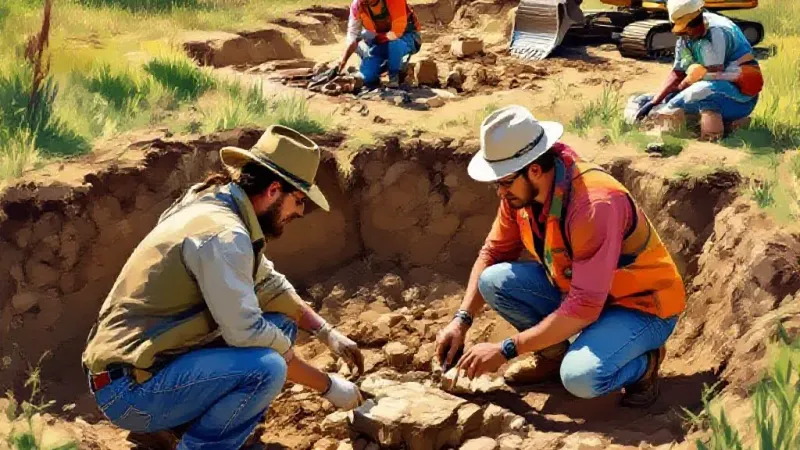
Archeologists have located seven coffins containing human remains near the North Dakota governor’s residence in Bismarck, on a site previously used as the city’s first community cemetery. The discovery was made during excavation work near 4th Street and Boulevard Avenue and has brought to light an unexpected aspect of Bismarck's early history, as it was previously believed that most graves had been relocated decades ago.
Preliminary analysis of the remains inside the coffins indicates they belonged to two women, two men, two teenage boys, and a toddler, as reported by the Office of Management and Budget (OMB) to People. Contractors first uncovered remains, coffin hardware, and fragments on May 19 while performing excavation on the southwest corner of the property. This discovery immediately paused construction at the site.
Following the initial find, the State Historical Society conducted a radar scan. This led to a formal dig, which commenced on September 1. Office of Management and Budget (OMB) Facilities Management Director Brandon Solberg stated that crews investigated over 80 spots before concluding their fieldwork in early September. The coffins and an additional wooden box were located during this extensive investigation.
The archaeologists’ analysis of the remains and found items is expected to conclude early next year. After analysis, the remains will be carefully stored. Plans are in place for them to be reburied at a local cemetery in the future.
The site served as Bismarck’s first community cemetery from 1873 until 1877. During that time, community members laid their loved ones to rest there. It was widely believed that the majority of these graves had been successfully relocated to other cemeteries in the years following its closure. However, the recent discovery "has kind of proven otherwise," according to State Historical Society of North Dakota spokesperson Kara Haff. Haff noted that they had thought in the 1880s that everyone had been exhumed. An article from that era even suggested that only two individuals remained, with plans for their relocation within a week, a belief now contradicted by the new findings.
The historical significance of this burial ground was also reflected in a November 8, 1883, Bismarck Tribune article, which was highlighted by writer Jim Davis in a 2012 Public Prairie Newsroom piece. A reporter from the Tribune visited the “Old Graveyard on the Hill” and wrote about the then-humble tombs, which were "far distant from town" not long before. The reporter reflected on the city's "phenomenal growth" and observed the "lowly graves of the pioneers and frontiersmen who died fighting the battles" that secured the ground for future generations. The article also touched on the plans to move graves, noting how rapidly settlers could be forgotten.
The broader importance of such sites was underscored by Morton County Commissioner Andy Zachmeier in a 2021 KXNET report. Zachmeier discussed how abandoned cemeteries, including the Bismarck site, hold a significant part of the state’s history. He told the outlet at the time that "these are the people that came and settled. These people paid a heavy sacrifice to start a life here, they helped build that county and the state of North Dakota.” The discovery near the governor's residence serves as a tangible reminder of these early settlers and their contributions to the region.