Early in-person voting has begun in Burleigh County, with a Bismarck-area organization actively working to encourage Indigenous residents to cast their ballots.
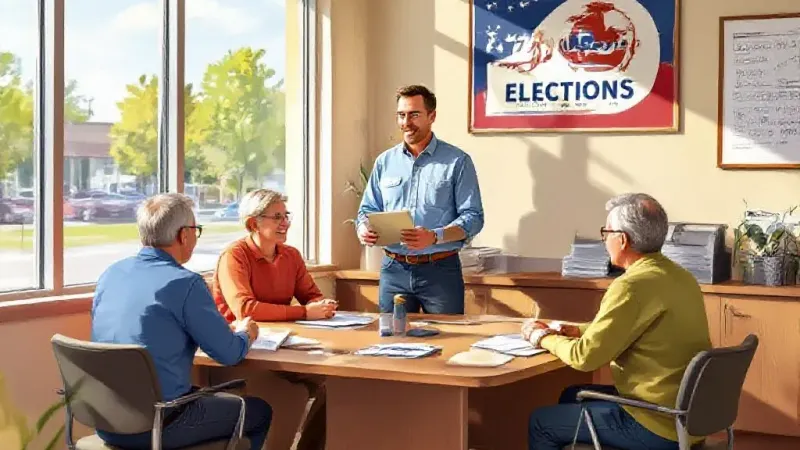
Staff from the Sacred Pipe Resource Center gathered Thursday with half a dozen local voters at the Bismarck Event Center, where they collectively cast their ballots shortly after polls opened for Burleigh County’s early voting period. Participants wore matching black T-shirts that read “Democracy is Indigenous” and took photographs together before heading inside to vote.
Daniela Aki, the center’s director of civic engagement, stated that the voting process can often feel confusing or intimidating, and having support can be beneficial. Aki elaborated that a key goal of the center is to "bring down those barriers to voting" and assure community members that the process is not daunting.
Among those who voted with the group was Leta Killer, a citizen of the Mandan, Hidatsa and Arikara Nation. Killer expressed a desire for change, particularly within North Dakota, and voiced support for two specific ballot measures: a proposed $116.5 million Bismarck school bond issue intended for facility upgrades, and a statewide initiative for free breakfast and lunch for K-12 students. Killer emphasized a wish for improved community relations and a better collective environment.
Victoria Fox, who works as the outreach and development coordinator for the MHA Education Grant Program, also participated. Fox cited the school bond referendum as a significant motivator for her vote, aiming to enhance the schools her 3-year-old and 1-year-old children will eventually attend, viewing it as a parental advocacy.
The Sacred Pipe Resource Center mobilizes urban Indigenous residents for voting parties through partnerships with other organizations and word-of-mouth efforts, Aki explained. Beyond voting parties, the center also runs initiatives like civic bingo, designed to inform residents about candidates and public offices. Another program includes chaperoned limousine rides for students who have turned 18, allowing them to cast their first vote in a memorable way. Aki noted that the Sacred Pipe Resource Center has consistently encouraged the urban tribal population to be civically engaged and to use their voices to help shape their communities.
Aki identified identification and address requirements as frequent barriers for urban Indigenous voters, many of whom originate from various reservations and states. These residents may be transient, possess outdated identification, or be unaware that addresses such as a church or shelter can be used for voting purposes. In an effort to ease the process for Native voters, the Sacred Pipe Resource Center advocated for the inclusion of all five tribal IDs in North Dakota’s state poll worker training.
Burleigh County Auditor Mark Splonskowski confirmed that any voter presenting a tribal ID should be processed without issue, stating that it is an improvement they are pleased to implement. Aki further commented that some Native voters may experience nervousness or a feeling of not belonging, partly because voting is not an everyday activity. She observed that if urban tribal populations are not conditioned to engage in activities like voting, they often do not participate. Aki advised residents to utilize early in-person voting to avoid potentially long lines on Election Day.
Early in-person voting is expanding across the state in the coming week. Stutsman and Ward counties began early in-person voting on Monday, followed by Cass, Grand Forks, and Morton counties on Tuesday. Stark County is set to begin early voting on October 29. Sioux County will offer several days for absentee voting from October 26-30.
Absentee voting has been an option for North Dakotans since September 24. State online voting numbers indicated that nearly 30,000 ballots had been cast statewide by Thursday afternoon. Absentee ballots must be submitted before polls close on Election Day, November 3. Voters can return these ballots in person, via mail, or through county dropboxes, but they will not be accepted at polling locations on Election Day. Ballots received after Election Day will not be counted.
Secretary of State Michael Howe noted that midterm elections historically see lower voter turnout, citing North Dakota’s barely 43% turnout in the November 2022 general election. Howe expressed a desire for 100% engagement, believing that greater participation from every eligible North Dakotan provides a more representative reflection of the overall electorate’s sentiment.