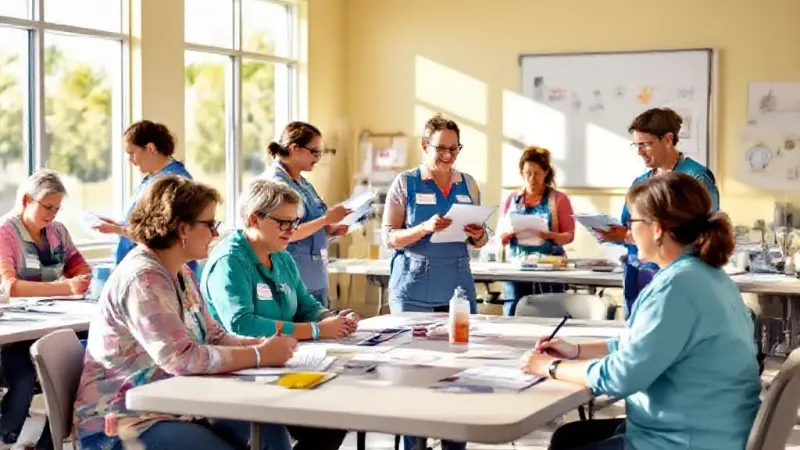
BISMARCK — Poll workers and county election officials across North Dakota are set to manage Election Day operations following nearly a year of intensive preparation, early voting administration, and primary election duties, North Dakota Monitor reported.
Local election staff state that the seamless operation of statewide elections relies on continuous training streams flowing from the Secretary of State’s Office to county auditors, who then train local precinct workers and election judges. Training activities begin early in the calendar year and extend past the final meeting of the state canvassing board in November.
In Morton County, election judge Paulette Neff, who has worked elections for 15 years, noted that direct voter education forms a central part of her duties on Election Day. Neff told North Dakota Monitor that she routinely reviews ballot instructions with voters prior to handing them their materials. She explained that many voters mistakenly believe they must complete every contest on the ballot. Neff emphasizes to voters that they should take care not to overvote, which occurs when a voter selects more candidates than allowed, causing the voting machine to reject the ballot.
In Stutsman County, precinct inspector Linda Chadduck, who previously served 37 years as county election staff before retiring in 2016, emphasized the behind-the-scenes effort required to prepare polling places. Chadduck, recognized by the Secretary of State’s Office as the 2026 Election Hero, noted that she frequently works to correct public misinformation regarding voting mechanics.
When alerted by a friend to a false social media post warning voters to reject initialed ballots, Chadduck clarified that election judges must place their initials on every ballot issued. She told North Dakota Monitor that if a recount occurs, any ballot lacking official initials cannot be counted. Chadduck has also addressed false public claims regarding voting machine security, explaining that the tabulation machines are not connected to the internet and lack any physical port or capability to connect to network lines.
In Richland County, Auditor Sandy Fossum, a past president of the North Dakota Auditors and Treasurers Association, reported that while many precinct workers bring years of experience to their positions, new poll workers are also entering the system this year. Fossum provides one-on-one instruction to assist workers who have detailed operational questions to help ensure a smooth process for workers and voters alike.
Polling locations across North Dakota open Tuesday morning between 7 a.m. and 9 a.m., depending on the specific site, and close at 7 p.m. local time. State law does not require voter registration. To vote, residents must present acceptable identification, such as a North Dakota driver’s license, a state-issued non-driver identification card, a tribal ID card or official tribal letter, or an authorized certificate from a long-term care facility.
Statewide measures on this year's ballot include proposed constitutional amendments and a measure regarding free school meals. Voters are also selecting several statewide office-holders and electing North Dakota's sole representative to the U.S. House of Representatives.
All absentee ballots must be received by 7 p.m. on Election Day. State election rules prohibit returning absentee ballots at individual polling locations; instead, voters must deliver them directly to their county auditor's office or place them in an official county drop box.
Official vote totals will begin posting on the Secretary of State’s website at 8 p.m. Central time. Fossum noted that initial reporting delays can occur because any voter standing in line by 7 p.m. is legally permitted to cast a ballot. Additionally, precinct workers in rural areas often must drive up to 50 minutes to hand-deliver vote totals and materials to their county courthouses before totals can be officially verified.
Data from the Secretary of State’s Office shows that more than 101,000 North Dakotans had already cast their ballots through early voting methods as of Monday evening for the 2026 election. During the 2022 midterm election, overall voter turnout reached nearly 43 percent, with more than 242,000 residents casting ballots.