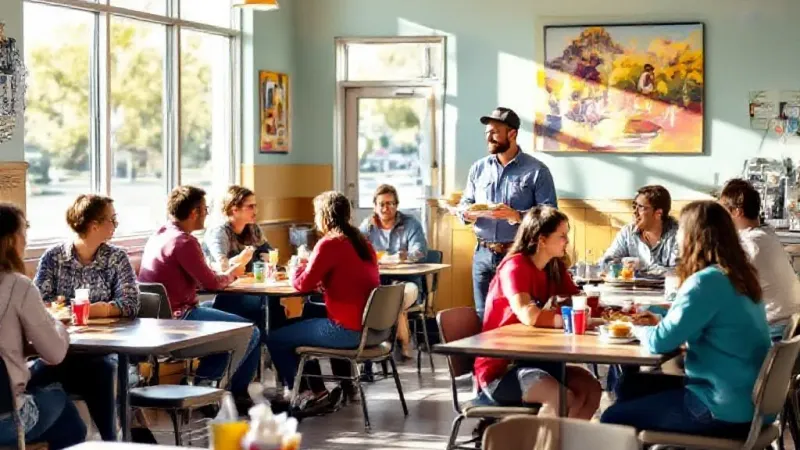
North Dakota voters this fall will decide on Measure 2, a ballot initiative that proposes to provide free breakfast and lunch for K-12 students across the state. The measure, which impacts an estimated 125,000 K-12 students, including those attending schools in Bismarck and Mandan, could cost as much as $134 million every two years.
Supporters, like Zac Ista, the Democratic House minority leader from Grand Forks, argue the measure would ensure every student receives nutritious meals and could save families as much as $1,000 per student per school year. Ista, who debated the measure on the Plain Talk Podcast hosted by Rob Port and Chad Oban, stated that ensuring children are well-fed leads to better learning outcomes and helps them meet their potential in the classroom. He also connected the measure to the state constitution’s requirement of a uniform system of free public education and an existing state law that mandates no student be turned away from lunch due due to inability to pay. Ista noted that the economy is a top concern for voters, and this measure offers a direct way the state can respond to economic pressures. He further pointed out that the Legislature has defeated past bills for free school meals, leading many to believe a constitutional protection is needed.
Opponents, including Bob Harms, a former state GOP chair and legal adviser to two past governors, criticized the measure as a constitutional amendment, arguing such changes require a vote for potential future modifications and represent the wrong policy direction. Harms, also debating on the Plain Talk Podcast, labeled the measure as “wasteful spending” because it would apply to all schoolchildren regardless of their family’s income. He highlighted that the state already allocates $40 million annually to feed needy children, with nearly all of this funding derived from federal sources. Harms contended that embedding such a policy in the constitution is inappropriate for day-to-day policy adjustments, especially when Republican Governor Kelly Armstrong is calling for budget cuts as high as 10% for some state agencies. He suggested that if the goal is to ensure students don't go hungry, existing policy should be adjusted by the Legislature, not mandated in the constitution.
The proposed funding mechanism for Measure 2 would mandate meals be covered by earnings from the state’s $15 billion oil tax savings fund, known as the Legacy Fund, if the Legislature cannot find alternative funding in addition to required federal reimbursement. Harms expressed concern that this backstop impedes the Legacy Fund’s primary purpose: to safeguard the state’s financial future in the event that oil tax revenue diminishes. The measure does require school districts to “maximize federal reimbursement” for meals.
The debate also touched upon broader constitutional principles. Harms argued that North Dakota’s constitution should represent fundamental principles for managing state government, not specific policies that might need frequent adjustment. He cited the potential complexity of losing federal funds as another reason the measure should not be enshrined in the constitution. Ista, however, countered that voters have shown a willingness to make technical constitutional changes, referencing a Legacy Fund measure in 2024. He also stated that the Legislature would retain flexibility in how to fund the meals under the measure, noting the funding amount is a small fraction of the state’s overall $20 billion two-year budget.
Moderator Chad Oban, who also serves as executive director for North Dakota United, a public employees and teachers union that has contributed at least $210,000 to Together for School Meals, the group behind Measure 2, questioned why school meals are treated differently than textbooks or transportation. Ista responded that meals follow the same principle as other services schools already provide, while Harms questioned, “Why not shoes and clothes as well? What’s the difference?”
Together for School Meals has raised over $1.4 million in monetary donations, including $760,000 from the Fairness Project, a D.C.-based organization. Harms voiced concern about the Fairness Project's involvement, questioning why they are "trying to manipulate the people of North Dakota" and stating voters have been "duped" by out-of-state groups previously. Ista maintained that Measure 2 is a genuine grassroots issue for North Dakotans and that voters ultimately vote for what they want. The Fairness Project has also spent more than $1.1 million opposing Measure 1, which would require at least 60% voter support to amend the constitution. Measure 2, by contrast, needs only a simple majority to pass.