
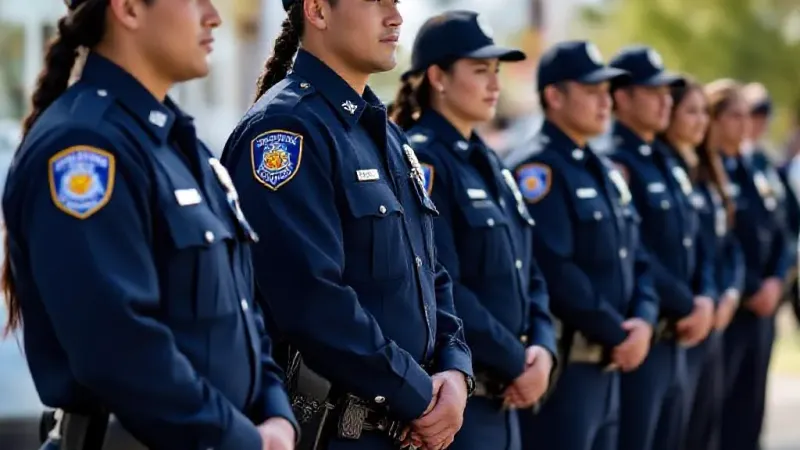
Twelve tribal police recruits from nine tribal law enforcement agencies are set to graduate Tuesday from North Dakota’s first basic law enforcement training class at Camp Grafton Training Center near Devils Lake. This new 14-week Indian Country Police Officer Training Program marks a significant expansion of training opportunities within the state, providing an alternative to the U.S. Indian Police Academy in New Mexico. The establishment of this local option addresses long-standing challenges in recruiting new tribal police officers, according to leaders in North Dakota and other northern states.
One North Dakota tribal police recruit joined the pilot program from the Bureau of Indian Affairs' Turtle Mountain Agency. Other participants in this inaugural class hail from tribal nations in Washington, Nebraska, Wyoming, and Wisconsin. The program was also promoted to Idaho, Montana, South Dakota, Minnesota, and Iowa, according to Charles Addington, principal director for justice services and law enforcement for the Bureau of Indian Affairs. Tribal leaders have indicated that training closer to home could ease the burden on recruits and their families.
Jamie Azure, Chairman of the Turtle Mountain Band of Chippewa Indians, highlighted the benefits of local training, noting that officers are no longer required to travel long distances for necessary instruction. Azure added that proximity creates “more opportunity to more people.” Sgt. Mike Roy, a school resource officer for the Three Affiliated Tribes, echoed these sentiments, recalling his own experience training in New Mexico while his family remained in North Dakota. Roy described being away for five months as difficult, stating he would have preferred to be able to go home on weekends. Addington described the response to the new program as providing "renewed hope for many agencies across the northern region."
The training at Camp Grafton, a North Dakota National Guard base, involves nearly 600 hours of instruction across various disciplines. According to the Bureau of Indian Affairs, this includes report writing, court testimony, federal and tribal criminal law, emergency vehicle operations, firearms fundamentals, and arrest and control techniques. Addington further stated that all academy programs are taught by subject-matter experts with extensive experience working in tribal communities, handling complex and sensitive investigations often encountered in Indian Country.
While Camp Grafton previously offered advanced law enforcement training for the BIA, basic training options were solely available in New Mexico. This distance was identified as a barrier to recruitment by leaders in North Dakota and other northern states. The current program is a pilot offering, with a goal to assess Camp Grafton’s capabilities as a training site and ensure adequate resources, facilities, and instructors are in place for future basic law enforcement courses, Addington explained. The Bureau of Indian Affairs plans to offer multiple tribal basic law enforcement courses over the next year, each accommodating 24 to 36 officers. Additionally, the bureau will feature basic training for tribal correctional officers and specialized training for both tribal police and corrections officers in areas such as missing persons, defensive techniques, child and elder abuse, and high-risk traffic stops.