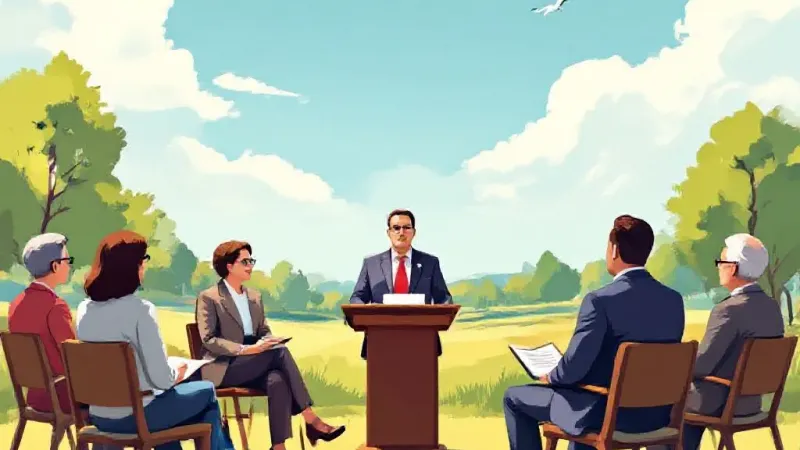
Six candidates vying for three open seats on the Burleigh County Commission engaged in a public forum Tuesday night, offering insights into their values, priorities, and approaches to key county decisions. The gathering, held ahead of the November election, provided residents an opportunity to hear directly from those seeking a four-year term in public office. Discussions touched on how the candidates would handle crucial administrative choices, as well as their perspectives on previous commission actions, including the extent of county control in collaborative projects with the city of Bismarck.
Two current commissioners, Wayne Munson and Steve Schwab, are seeking re-election, while Commissioner Jerry Woodcox has chosen not to run again, ensuring at least one new face will join the board. The forum explored the various candidates' stances on critical issues impacting Burleigh County residents.
Candidate Mark Wagner specifically addressed the issue of county control in joint projects with the city of Bismarck. He questioned why the county had not pursued joint powers with the city on these projects, noting that the city had previously suggested working together. Wagner's remarks highlighted a perceived missed opportunity for collaborative governance between the two entities on significant local developments and infrastructure initiatives. His concern pointed to a desire for stronger, more coordinated efforts in projects that impact residents across both jurisdictions.
Kay Lacoe articulated her commitment to the development of the Missouri Valley Complex. Lacoe emphasized her dedication to transforming the complex into a vital "social and economic center for Burleigh County," benefiting the wider community. While acknowledging she is not a single-issue candidate, Lacoe stressed her unwavering commitment to harnessing the potential of this specific site to foster growth and community engagement, indicating a strong focus on strategic development within the county.
Current Commissioner Wayne Munson, seeking re-election, took the opportunity to defend his record against criticisms labeling him as a "spender." Munson outlined his strategic financial goal for the 2027 budget, which centers on reducing long-term costs for the county. He proposed a shift from relying on subcontractors to investing in county-owned equipment, explaining that such an approach would lead to a "long-term investment so that we can slowly reduce the cost to residents over time." This strategy, Munson suggested, aims to create enduring financial benefits and efficiencies for Burleigh County taxpayers over the coming years by building county assets.
Fellow incumbent Steve Schwab, also running for another term, focused on the critical process of filling important county positions. Schwab shared his insights on the challenges involved in securing qualified personnel for key roles, noting that it often requires significant effort. He emphasized that finding the right individuals often "took perseverance" and that the process demands time and persistence, underscoring the importance of diligent and persistent recruitment to ensure effective county operations and administration.
Jim Small advocated for a continuous focus on fostering business and economic opportunities within the county. He expressed a desire to attract more businesses to the area, indicating that a proactive approach to economic development is beneficial for Burleigh County. Small stated his availability for discussions on such matters, affirming that his phone is "always on" to engage with community members and stakeholders about potential growth initiatives and how to expand the local economy.
Mark Splonskowski addressed the broader context of public service, responding to negative campaign coverage by reminding voters of the core purpose of seeking elected office. Splonskowski clarified that the essence of being in public service is inherently communal. He emphasized that the role is fundamentally about the community, stating, "It’s public service," highlighting that the position is dedicated to the community's welfare rather than personal gain or individual agendas, urging a focus on the shared objectives of governance.
Each candidate also responded to questions regarding specific commission decisions they had disagreed with, providing further insight into their governing philosophies. The forum served as a critical platform for the six candidates to articulate their visions for Burleigh County's future. With three seats open and two incumbents seeking re-election, alongside the departure of Commissioner Jerry Woodcox, the November election is poised to shape the direction of county governance for the next four years. Voters in Burleigh and Morton counties will consider these diverse perspectives as they decide who will represent them on the commission.