
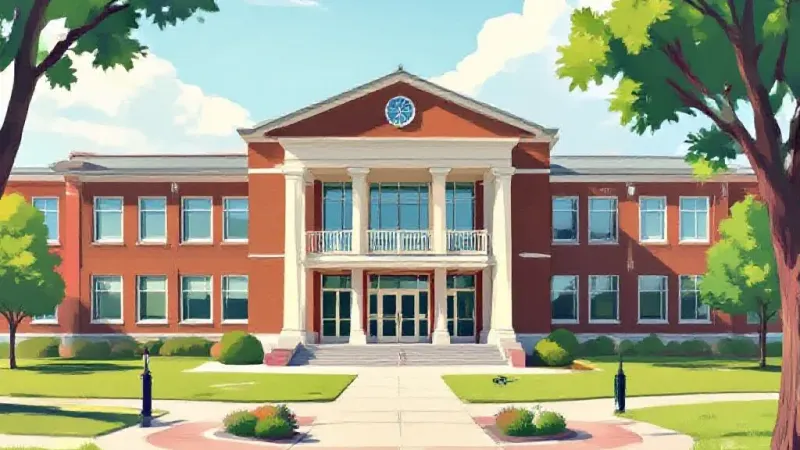
A 15-year-old student at Benson Polytechnic High School in Portland, Oregon, is facing serious charges including attempted murder and domestic terrorism following an incident on September 8 where toxic chemicals were mixed in the school cafeteria. Portland Police reported the student brought common household chemicals from home and combined them, causing the teen to pass out after inhaling the resulting toxic gases.
Investigators identified the mixture as hydrogen sulfide and hydrogen cyanide. Multnomah County Deputy District Attorney Eric Zimmerman stated that at least seven students and staff required medical care following the incident, and more than 100 individuals were checked at the school that day. Zimmerman indicated investigators believe more people could have been harmed by the chemicals.
The student appeared in court on Friday afternoon, where a first-degree domestic terrorism charge was announced. Later that day, the Multnomah County District Attorney’s Office also announced twelve counts of attempted murder in connection with the incident.
Surveillance video obtained by investigators showed the suspect arriving at school in gloves and dark clothing before pouring chemicals from a white jug. A subsequent search of the student’s home reportedly uncovered numerous dangerous chemicals and reactive substances, including materials that could be used in thermite-type mixtures. Authorities also found social media posts discussing the creation of acetone peroxide.
Prosecutors cited additional social media posts referencing a “kill/death ratio,” alongside language indicating self-harm and a desire to cause death to himself and others. Benson Vice Principal Joe Metassik acknowledged that the teen had been a responsible student previously, but described the incident's effect on students as “terror,” noting difficulties in getting children to return to school.
Further investigation by the FBI is underway, reviewing seized papers, hard drives, and computers. Deputy District Attorney Zimmerman noted that these materials included extensive references to “764,” which he described as a violent extremist group.
During court proceedings, defense attorney Norah Van Dusen acknowledged the gravity of the allegations. She submitted letters from the teenager’s personal psychiatrist and a psychiatrist at the Perry Center, both recommending continued psychiatric care. Van Dusen emphasized that the Perry Center is a locked and secure facility, without access to the outside world or social media. She stated that the teen remains at high risk of suicide, has a serious depression diagnosis, and is cooperating with treatment, but faces a long recovery process.
Van Dusen also highlighted the teen’s strong family support, with his father present in court and visiting daily at the Perry Center. She noted that the student appeared voluntarily, has not attempted to flee, has no prior court history, and has stable placement at the Perry Center. The defense requested the teen’s release to his father to continue medically necessary treatment at the center.
The teen’s father supported the current placement at the Perry Center, mentioning his son was only one week into a program typically lasting six to eight weeks. Benson parents like Loressa Williams and Ryan Branstetter also voiced their hope that the 15-year-old receives the help he needs.
The judge followed the recommendation from the Juvenile Department, ordering the teen’s release to his father with the condition that he immediately return to the Perry Center. Additional conditions include attending all future hearings, not attempting to run away, and remaining in the program. A subsequent hearing has been scheduled in approximately six weeks to determine future custody status after the treatment program concludes. However, prosecutors immediately asked the judge to reconsider the decision, prompting a re-hearing scheduled for Tuesday afternoon before a circuit court judge.